Blade Runner is one of the most popular
and influential science-fiction films of all time - and it has become an enduring cult classic favorite. It was directed
by Ridley Scott and stars Harrison Ford, Rutger Hauer and Sean Young. The screenplay, written by Hampton Fancher
and David Peoples, is loosely based on the novel Do Androids Dream of Electric Sheep? by Philip K. Dick.
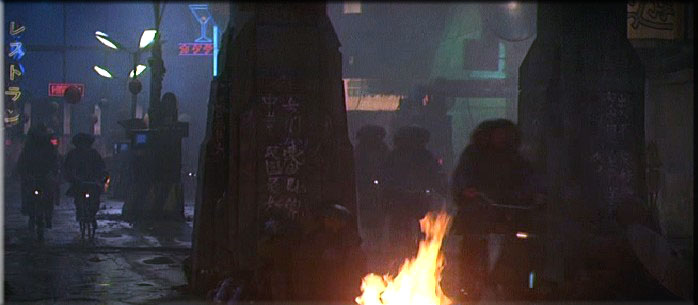
This 1982 film depicts a dystopian Los Angeles in November
2019. It has become a dark, polluted and overcrowded city dominated by cloud-piercing buildings and looming
neon billboards, the air dense with acid rain and flying traffic, as well as Replicants - human androids. Deckard's former
job in the police department was as a blade runner, a euphemism for detectives that hunt down and "retire" rogue replicants.
Deckard is forced back into active duty.
Blade Runner is more than
a movie. Not only does Blade Runner overwhelm the senses, it preys on our morals. It reveals fundamental truths
and insight about human nature.
Blade Runner opens up a multiverse of perspectives for those who seek them. The further we journey through it’s
sectors, the more there is to marvel at and amaze us. From the book, “Do Androids Dream of Electric Sheep?”
by Philip K. Dick; the various screenplays; the different versions of the movie Blade Runner; to the many off-spring this
work has spawned, we continue to keep alive this story. It has been analyzed, replicated, expanded upon and been paid tribute
to by all means known to Man. We can see it’s influence in other books and movies. It has been rendered in the visual
arts; in painting, sculpting, computer animation, architectural designs and even in fashion design. We can experience Blade
Runner virtually with video games. We can listen to Blade Runner inspired music. This paradigm has been presented in
live theatre productions, in dance recitals and on home video productions. Writers across the web have kept the story of Rick
Deckard and company alive in fan-fiction. In a sense, Blade Runner has been mythologicalized.
This website is for the Blade Runner
Enthusiast, the writer, the artist, the dreamer and the mythmaker.
Here you will find poems, scripts, stories and
art related to and inspired by the Blade Runner multiverse.
• KippleZone's YouTube Channel Blade Runner Enthusiasts and Dickheads
(Philip K. Dick fans) take to the camera! Here are fan-films shared on the YouTube website. A new breed of Blade Runner and
Dickian fandom has been unleashed!
•DADoES & Blade Runner Glossary Terms from the Philip K. Dick book "Do Androids
Dream of Electric Sheep?", the movie "Blade Runner", and the Westwood Studios computer game "Blade Runner".
• KippleTid-bits and kipple that have a connection with the Blade Runner multiverse.Features
CITYSPEAK, (the first Blade Runner fanzine), Penfield, (a Penfield mood organ parody), Blade Runner sequels, games,
exclusive articles and links to everything pertaining to Blade Runner and DADoES, from scripts to fan sites.
• KippleZone's Forum A place for Blade Runner Enthusiasts to chat.
Also contains more fuel for thought.
• Off-World NewsKeep up to date on special events involving
the Blade Runner multiverse!
•
Off-World CommunityThe
Off-World Community Grid Team consists of "users" who are also fans of the book DADoES, and the movie Blade Runner, undertaking
projects that benefit humanity. Grid computing joins together many individual computers, creating a large system with massive
computational power that far surpasses the power of several supercomputers. Come join us!
Blade Runner
is more than just a movie. It's a mythology.
Just when you thought Blade Runner couldn't get any better, along comes MEMORIA!
This is a five piece band performing original material to the back-drop of the movie Blade Runner. Formed in Italy, this rock
oriented ensemble debuted the Blade Runner Rock Project in 2006. In 2007, I joined the team and wrote the
English lyrics for this production. Read all about it here!
Douglas Trumbull: In Retrospect
Compiled and Edited by C.A. Chicoine
This article is based on a retrospective film series
I attended given by Douglas Trumbull in October of 2006. Although my focus is on the movie Blade Runner, I
have included highlights of Mr. Trumbull's career as a means to enlighten the reader unfamiliar to him and
his work. As a result, I have integrated previous interviews, articles and materials on Mr. Trumbull into this article.
Philip K. Dick's novel "Do Androids Dream of Electric Sheep?" (DADoES) is
published.
1974
DADoES is optioned by Herb Jaffe Associates, Inc. for film. Robert Jaffe
wrote the screenplay "Electric Sheep". PKD disliked it.
1975
DADoES was recommended by a friend of Hampton Fanchers' to obtain the optioning.
1977
Brian Kelly and Hampton Fancher buy the option for DADoES.
1978
Michael Deeley began submitting Fancher's adaptation of DADoES to different
studios and directors.
1979
• Hampton
Fancher worked on second draft of screenplay, given the title "Android", then later re-named "Mechanismo". Then, by third draft, "Dangerous Days".
1980
• Ridley Scott signed on as director.
• Screenplay
title changes to "Blade Runner".
• David Peoples
hired to rewrite script.
• Filming
starts for Blade Runner.
1981
Vangelis was signed on as soundtrack score composer.
1982
• Philip K.
Dick dies while the movie is being edited.
• The Denver
and Dallas "sneak previews".
• Voice-overs
added to Blade Runner.
• "Hollywood
Happy Ending" added to Blade Runner.
• San Diego
"sneak peek".
•
The Blade Runner movie is released to theaters.
• Orchestra Adaptation of Blade Runner soundtrack released.
• DADoES novel is re-released with a Blade Runner cover.
• Marvel Comic releases comic book editions of Blade Runner.
•
Ertle Blade Runner cars collection.
•
Blade Runner: A Story of the Future" released by Random House books.
•
"The Illustrated Blade Runner" & "Blade Runner Sketchbook" & Blade Runner
Portfolio released by Blue Dolphin.
•
Blade Runner Souvenir Magazine released by Ira Friedman, Inc.
1985
The CRL Group PLC released the Blade Runner computer game for Commodore 64
and ZX Spectrum.
1987
The original "theatrical release" of Blade Runner is released on video.
1992
The "director's cut" version of Blade Runner is released on VHS after being
shown at the Toronto film festival.
1994
The "Vangelis Blade Runner" sound track is released.
1995
• "Do Androids
Dream of Electric Sheep?" audio book released.
• The novel "Blade Runner 2: The Edge of Human" by K. W.
Jeter is published.
1996
• The novel
"Blade Runner: Replicant Night" by K. W. Jeter is published.
• The book
"Future Noir : The Making of Blade Runner" by Paul M. Sammon is published.
1997
• The Blade
Runner game for Windows 95 + Windows NT is released by Westwood Studios.
• Blade Runner
(The Director's Cut)DVD released.
2000
• The novel
"Blade Runner: Eye and Talon" by K.W. Jeter is published.
• Blade Runner
(Limited Edition Collector's Set) DVD released.
2006
Blade Runner - The Director's Cut (Remastered Limited Edition) DVD released.
2007
Release of "Blade Runner: The Final Cut". Formats available:
five-disc Ultimate Collector's Edition DVD, four-disc Collector's Edition DVD, two-disc Special Edition DVD, five-disc Ultimate
Collector's Edition Blu-ray, five-disc Complete Collector's Edition Blu-ray, five-disc Ultimate Collector's Edition HD DVD,
five-disc Complete Collector's Edition HD DVD.
"Blade Runner: The Final Cut" opens in select theatres throughout the
world.
Blade Runner Trilogy: 25th Anniversary - Vangelis soundtrack. It's a
3-CD set which - for the first time - puts all the pieces together, providing the complete music from the film and a lot more
besides. CD 1 features the original and remastered soundtrack as it first appeared in 1994, twelve years after
the film was released. The second CD contains all the remaining music from the film that did not appear on the original 1994
soundtrack, plus two bonus tracks ('One Alone' and 'Desolation Path'). None of this material has been released before. The
third and final disc will be of real interest to Vangelis fans, as it contains an entire album of newly written material composed
by Vangelis to mark the 25th anniversary of Blade Runner. The music is strong and flowing, and retains the dark, atmospheric
sense of the original score. There are some intriguing spoken word contributions too, from Ridley Scott, Roman Polanski, Oliver
Stone and a host of distinguished actors, personalities and world dignitaries.
Release of Official Blade Runner movie tie-in novel "Do Androids Dream
of Electric Sheep" by Philip K. Dick. Contains an article at the end of the book by Paul M.Sammon, titled "Of Blade Runners,
PKD, and Electric Sheep."
Release of Official Blade Runner movie tie-in novel "Do Androids Dream
of Electric Sheep" by Philip K. Dick, audio book,unabridged. Scott Brick (Narrator).
Release of "Future Noir: The Making of Blade Runner", Second Edition (Hardcover) by Paul M. Sammon
2009
Release of "Do Androids Dream Of Electric Sheep?," comic book series
by publisher Boom Studios.
This site is owned and operated by C.A. Chicoine. No material from the site may be copied, reproduced, republished,
uploaded, posed, transmitted, or distributed in any way, except that you may download one copy of the materials on any single
computer for your non-commercial use only, provided that you keep intact all copyright and other proprietary notices. Modification
of the materials or use of the materials for any other purpose is a violation of this site owner's copyright and other proprietary
rights. The use of any such material on any other Web site or networked computer environment is prohibited.
Music heard in background is from the movie Blade Runner. "Pompeii 76 A.D.", from the album"Harps Of The Ancient Temples", conceived and performed by Gail Laughton.